When evacuation is delayed for twelve hours or longer, equipment planning takes on a different meaning. Identifying a monitor or ventilator that can be brought into a shelter is only the beginning. We need to know who will operate it throughout that period, how the team will assess the casualty, and what will happen when batteries, consumables or oxygen run out.
As a military physician and instructor, I see this primarily as an organisational challenge. The question is not whether a combat medic can learn to use more sophisticated technology. It is whether the conditions are in place for a trained team to use it properly. Delivering a device and establishing a capability to provide care are different outcomes.
Twelve hours is a scenario, not a definition
This article considers a casualty collection point (CCP) in a shelter where evacuation has been delayed. A CCP is not synonymous with a stabilisation point. Nor does adding a monitor, blood analyser and ventilator automatically make it a Role 2 facility: a role of medical support encompasses a broader set of functions and organisational arrangements. This distinction is consistent with the definition of a CCP and the description of roles of medical support in AJP-4.2, July 2026 edition.
Prolonged casualty care (PCC) becomes necessary when evacuation constraints or mission requirements mean that care must continue beyond the capabilities or capacity ordinarily available. The Joint Trauma System (JTS) guidelines do not set a universal threshold of twelve hours. Here, 12+ hours is a planning scenario. The challenge may arise sooner, depending on casualty condition, workload and resources.
Initial interventions do not resolve the whole problem. MARCH covers Massive haemorrhage, Airway, Respirations, Circulation, and Hypothermia/Head injury. This expansion is used, for example, in a study of hypothermia in combat trauma. Completing initial interventions does not guarantee continued stability: reassessment, ongoing care and preparation for handover remain necessary.
The tasks of a particular CCP determine whether additional equipment is appropriate. Which casualties need the additional capabilities? What decisions will the team be able to make? Can those capabilities be sustained until evacuation? Without answers, acquiring a more sophisticated device may run ahead of the conditions needed to use it.
What equipment adds to clinical observation
My team had good medical equipment. At other stabilisation points, however, I saw considerably more limited equipment because of financial constraints: manual ventilation with a resuscitation bag, and monitors offering basic pulse rate, SpO₂ and non-invasive blood pressure measurements. These are personal observations from stabilisation points; conditions at CCPs may differ.
For me, this contrast raises questions about the tools available for observation and support. During a prolonged wait, we need to understand how the casualty's condition is changing: what has changed since the previous assessment, whether care is having the intended effect, and whether new problems have developed. Equipment can provide additional information or support a particular function, but each device addresses only part of the task.
A patient monitor does not offer the same capabilities in every model. A basic configuration may display pulse rate, peripheral oxygen saturation measured by pulse oximetry—SpO₂—and non-invasive blood pressure. Electrocardiography, temperature, capnography and other parameters depend on the model and installed modules. Procurement therefore needs to consider the actual configuration, sensors and cables, as well as the device name.
ECG rhythm monitoring is not equivalent to a diagnostic twelve-lead electrocardiogram. ECG changes may raise suspicion of certain electrolyte disturbances, but a monitor does not measure electrolyte concentrations. For example, the absence of characteristic changes does not exclude hyperkalaemia, as discussed in the UK Kidney Association's 2023 guideline.
SpO₂ helps assess oxygenation but does not replace assessment of ventilation. Capnography displays CO₂ in exhaled gas and its variation through the respiratory cycle; it is not a laboratory blood gas analysis. JTS Mechanical Ventilation Basics, 2025 revision emphasises interpreting measurements in clinical context: exhaled CO₂, for instance, may not accurately reflect arterial CO₂ in significant lung injury.
The practical purpose of monitoring is to help the team recognise changes and respond promptly. Someone must assess signal quality, distinguish a technical problem from a possible clinical problem, and document findings. A screen displaying numbers does not, by itself, establish that capability.
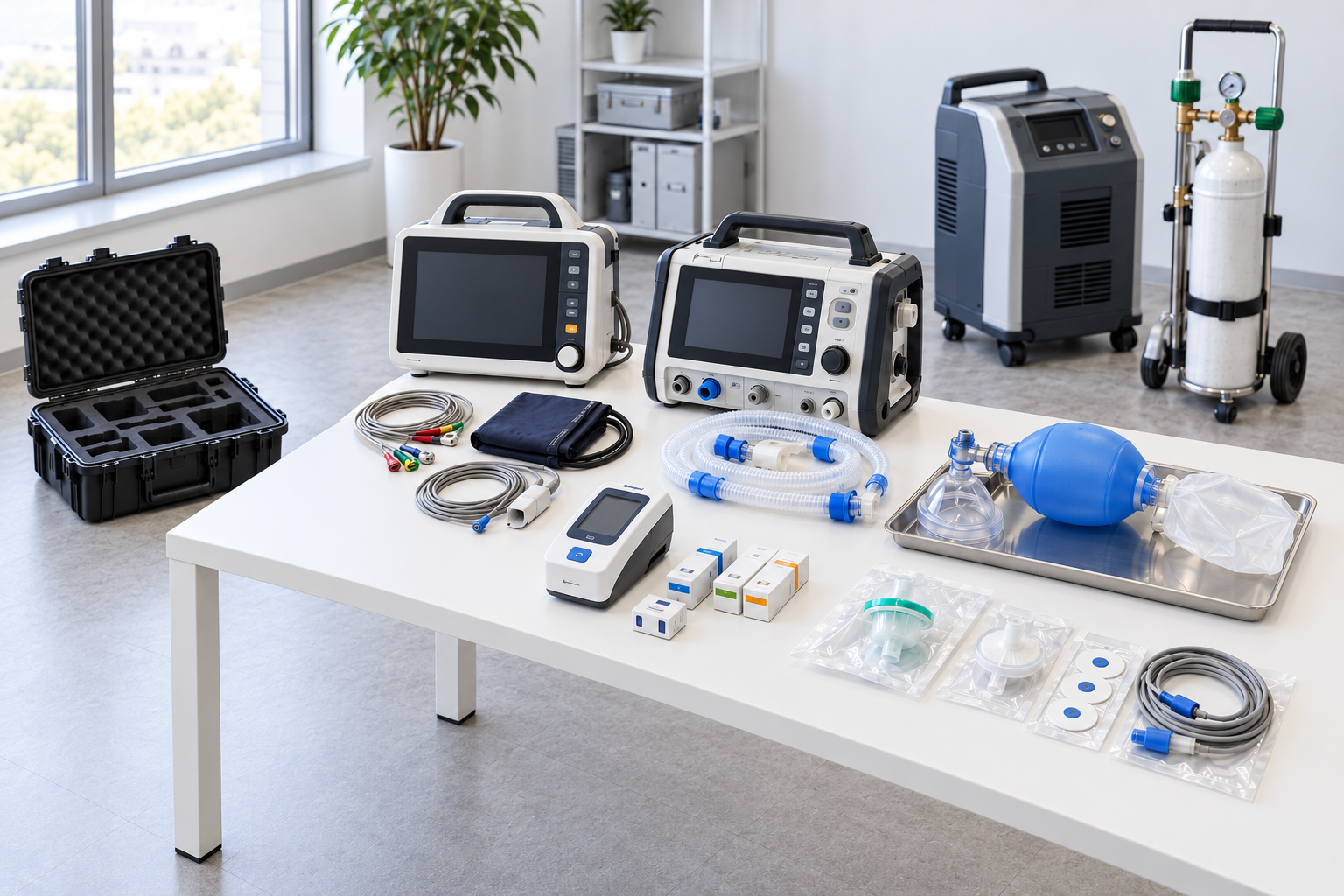
Medical equipment for monitoring, diagnosis and respiratory support. A trained team and the resources to sustain its work make these capabilities available to the casualty.
A blood analyser comes with its own requirements
A portable analyser allows some laboratory tests to be performed near the patient: point-of-care testing (POCT). However, the term “blood analyser” does not define the full range of available measurements. That depends on the model, cartridge or other test system. We cannot assume that a particular setup measures blood gases, electrolytes, haemoglobin and lactate together.
The guideline on i-STAT use in austere locations, revised on 26 February 2025, addresses cartridge selection, storage, quality control and sample handling separately. Written for the aeromedical environment, it illustrates how results depend on the entire testing process.
Suitable consumables, the specified temperature conditions, expiry dates and required quality checks all matter. So do blood collection and handling: haemolysis, exposure of the sample to air or delays in testing can affect results. The device may be functioning correctly while the data are unreliable because of a problem outside its housing.
Laboratory findings can help clarify a cause of deterioration and inform available decisions. They cannot identify every cause or guarantee survival until evacuation. The practical questions are: what decision would this result change, who will interpret it, and are the resources available to act on that decision? This connects diagnostics to the care the team can actually provide.
Ventilation, oxygen and humidification are separate parts of the system
A mechanical ventilator provides mechanical ventilation. It is not synonymous with an oxygen source. A complete equipment description needs to distinguish the ventilator itself, the source of airflow, the oxygen source and the breathing circuit components. The design of the particular model determines which external resources it requires.
A compressor or turbine generates flow and pressure; an oxygen concentrator separates oxygen from ambient air; a cylinder stores compressed oxygen. Not every ventilator needs a separate external air compressor. For example, the HAMILTON-T1 manual for software version 3.1.x describes the use of ambient air and an internal blower alongside a separate oxygen inlet. Other models must be assessed against their own documentation.
Oxygen source output cannot be equated directly with total breathing gas flow or minute ventilation. The mixture may contain both air and added oxygen. Compatibility depends on the ventilator's requirements for gas pressure, flow and quality, the connection method, and the source's ability to meet those requirements. A single figure in litres per minute does not describe the whole system.
A separate device is the manual self-inflating bag-valve resuscitator, often called an “Ambu bag”. It may be needed for ventilatory support and as a backup. However, prolonged manual ventilation requires continuous hands-on attention. The person providing it cannot simultaneously be counted as available for other tasks. Mechanical ventilation also requires ongoing observation of both the patient and the system.
Manual and mechanical ventilation can each use different oxygen supplies and humidification arrangements. These characteristics depend on the assembled system: the way airflow is generated does not, by itself, determine the gas mixture the casualty receives.
Invasive ventilation bypasses the upper airway's natural conditioning of inspired gas, so adequate warming and humidification must be provided by other means. Active humidification adds water vapour to the gas, for example through a heated humidifier. A heat and moisture exchanger (HME) passively retains some of the heat and moisture from exhaled gas and returns it during the next inspiration. These are different approaches with their own conditions of use.
The 2012 AARC humidification guideline and the 2024 AARC patient–ventilator assessment guideline emphasise assessing both the adequacy of humidification and the suitability of the selected device. An HME adds resistance and apparatus dead space—a volume in which exhaled gas can remain. Secretions, leaks and other limitations matter. Active systems have their own support requirements. Circuit selection therefore needs to account for the documentation and clinical needs rather than follow a universal rule to use one method every time.
Care is delivered by a team
The foundation of prolonged care is nursing care, reassessment, documentation and the transfer of responsibility between team members. Someone must observe the casualty, check positioning and skin condition, carry out the care plan and recognise changes. Monitors and ventilators support that work. Alongside clinical tasks, the JTS PCC principles explicitly address a nursing care plan, allocation of roles, documentation and team rest.
One model to consider is a combat medic trained at the Combat Medic/Corpsman (CMC) level, with additional training on the specific equipment, working with Combat Lifesaver (CLS) assistants. Within Tactical Combat Casualty Care (TCCC), these are distinct training tiers: CMC is Tier 3 and CLS is Tier 2. NAEMT describes CLS as training for non-medical military personnel; the designation does not imply a formal healthcare qualification.
Assistants can be trained for defined tasks: preparing a cable, applying a blood pressure cuff, placing electrodes according to a practised procedure, recording readings and reporting changes. This does not automatically authorise them to interpret results or make clinical decisions. Each task needs a designated person to perform it, someone to check it, and a clear route for seeking help.
The core CMC course likewise does not establish competence in every aspect of intensive care, laboratory diagnostics or mechanical ventilation. Additional skills, authorised activities, clinical oversight and access to consultation must be defined separately. The team needs to understand what it can sustain independently, when it needs help and which capabilities are unavailable on site.
This division of work must remain viable throughout the wait. Who stays with the casualty while another person handles communications? Who relieves a tired team member? What changes when a second casualty arrives? One person cannot simultaneously operate a ventilator, perform blood tests, maintain observation and coordinate evacuation. Staffing and opportunities for relief need to be considered alongside qualifications.
Shift handover is part of continuity of care. The incoming person needs to understand more than current readings: previous trends, interventions, unresolved problems and remaining resources also matter. Documentation preserves that picture and supports handover to the evacuation team. If the delay extends beyond the planned period, available support and staff workload need to be reviewed.
Training should be delivered by someone with practical experience of the specific equipment who understands its limitations and can explain its use to people without a medical background. Learning the menu is only the beginning. Preparation includes assembling the system, assessing its effect, recognising faults and switching to a backup method of care. Readiness means being able to perform these tasks, rather than simply having attended a session.
A team training scenario can test this through role allocation, shift handover, consultation and the failure of a component. The findings should identify specific gaps and guide further practice. If only one team member can explain how the system works, reliance on that person remains an organisational weakness. Readiness needs to be sustained through practice and reassessed after changes in personnel or equipment.
Consultation also needs a working arrangement. Who answers, what information is communicated, and what happens if the primary channel fails? JTS Telemedicine Guidance in the Deployed Setting, 2023, treats teleconsultation as a skill requiring planning and practice. A consultant supports decisions but cannot replace the people at the bedside or treatment resources on site.
Sustainment starts before a device is handed over
We received equipment from abroad for which compatible consumables and accessible servicing were difficult to find. For me, this is a clear example of why accepting a device must include considering its entire operational life. Receiving it at no purchase cost does not remove the cost of keeping it in use. The WHO's second edition of its medical device donation guidance, 2024, addresses donor and recipient responsibilities and the risks of inappropriate donations.
Equipment brought to a CCP is assembled for defined tasks and a projected workload. This allows planning beyond the contents of an individual medic's aid bag: the system includes the devices, compatible accessories, resources for the intended period of operation and the means to replenish them. The whole system needs assessment before procurement or acceptance of a donation, while its configuration can still be changed.
Power must be assessed for the full setup operating together: devices, charging, lighting and communications. A single device's rated battery life does not establish whether there is enough energy for the system. Actual battery condition, consumption under the planned workload, charger compatibility and switching between power sources without an unexpected interruption all matter. These should be checked without a patient, using the intended configuration and the manufacturer's specified tests.
Oxygen provision, where needed, requires a separate assessment: available stock or production, consumption by the particular system, replenishment and backup. Loss of electrical power may affect several components at once. Backup arrangements therefore need to be assessed for independence from the same cause of failure. Fire precautions and appropriate placement of oxygen equipment are also required, as addressed, for example, in the HAMILTON-T1 manual.
Consumables must be planned for the anticipated duration and number of casualties: circuits, filters, gas sampling lines, electrodes, cartridges and other components specific to the setup. Stock must also cover required checks and training. Quantities depend on the scenario and resupply options. Items with expiry dates need a clear inventory: what is available now, what needs replacing, and who is responsible for replenishment.
Storage and operating conditions must be checked against the documentation for the model. Portability alone does not establish acceptable temperature, humidity, dust or water exposure. Transport, cleaning and operating requirements may differ, and the team needs access to this information. Using equipment in a shelter calls for checking those conditions rather than assuming that every device is suitable only for a ward—or can withstand any environment.
Servicing must remain accessible after delivery. The condition of a used device, the service provider, parts availability and replacement arrangements during repairs all need to be known. Responsibility for technical condition must be as clear as responsibility for clinical care. A device awaiting repair with no clear return date cannot be counted as an available resource.
These activities also need to be distinguished. Maintenance preserves or restores device condition; a functional check assesses its operation; calibration establishes the relationship between reference values and instrument indications; and metrological verification confirms that a measuring instrument meets specified requirements. Successfully powering on does not replace these procedures. Calibration and verification are defined in Ukraine's Law on Metrology and Metrological Activity. The scope of the procedures, who may perform them and their applicability must be determined for the particular device under its documentation and applicable requirements.
Organising the working space
Access to the casualty, the routing of cables and tubing, screen visibility and the ability to notice an alarm affect the team's day-to-day work. Equipment must remain accessible for checks and cleaning, while supplies need protection from conditions that could damage them. These issues should be addressed during setup, while the layout can still be changed without interrupting care.
The layout should be assessed from the perspective of those who will care for the casualty and hand them over. Can they reach the patient without disconnecting essential components? Is it clear where each line leads? Can the system be packed for movement without improvisation? An attractive equipment display and a functioning clinical workspace serve different purposes.
Preparation should produce a clear account of available tasks and specific limitations: what the team can sustain, what is missing and which changes require the plan to be reviewed. This gives medical planners a basis for requesting support and helps the next team understand the site's actual capabilities.
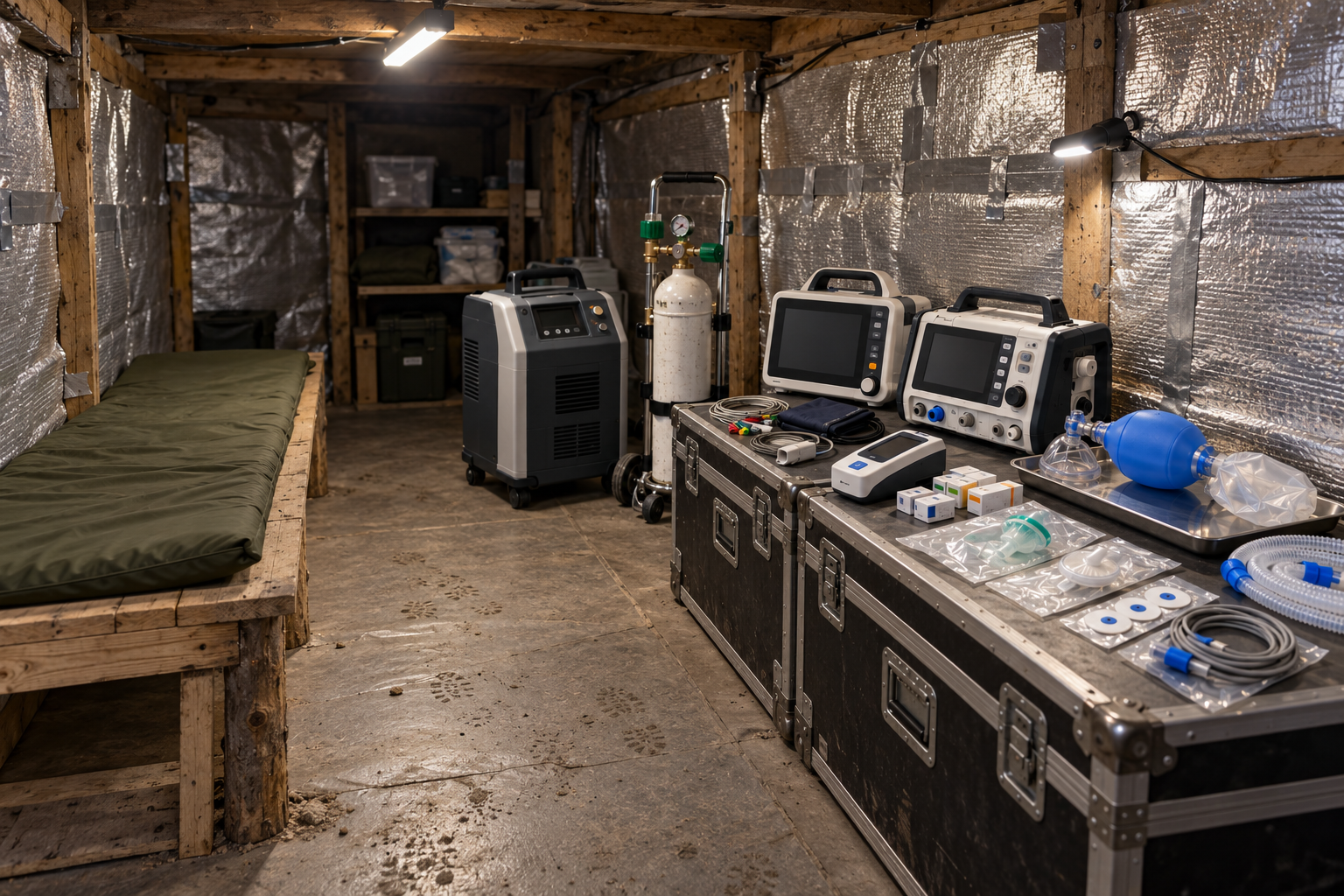
Organising teamwork, nursing care and monitoring at a casualty collection point during delayed evacuation.
What to expect from an equipment solution
Standardised care does not necessarily require identical brands. The starting point is agreed functional requirements: which tasks need to be performed, by whom, for how long and under what constraints. Available options can then be assessed against those requirements. Even devices in the same category may differ in their alarms, connections and checks; changing to an unfamiliar model requires familiarisation.
Developers should evaluate their solutions with users and engineers under representative conditions. Readability, understandable error messages, instructions available without internet access and the ability to assemble the system correctly all matter. These evaluations help identify practical barriers to use; clinical effectiveness requires a separate assessment.
The approach described here is a framework for planning and assessing a specific team and equipment configuration, rather than an approved equipment standard. Suitability depends on casualty needs, evacuation delays, team training and staffing, resupply options and operational safety. Additional capabilities support care during the wait, but do not remove the need to continue arranging evacuation.
Before deployment, the assessment can be brought together through these questions:
- Which tasks can the team perform, and what remains beyond its capabilities?
- Who is responsible for clinical decisions, nursing care, documentation and staff relief?
- What demonstrates readiness to work with this particular setup?
- Are power, oxygen where needed, and consumables sufficient for the planned duration?
- Are suitable operating conditions, storage and servicing in place?
- How will care continue after a failure and during evacuation?
The key criterion is whether the team can perform its defined tasks safely and continuously. That is the outcome against which equipping a CCP should be assessed.
Key sources
Documents were checked against the available official catalogues and materials as of 16 October 2026. The scopes noted below distinguish military guidance, professional recommendations and documentation for individual devices.
- JTS. Prolonged Casualty Care Guidelines, CPG ID 91. 21 December 2021; the v1.1 PDF listed in the current JTS catalogue includes a June 2023 rapid update. Document. Organisational principles, the definition of PCC and allocation of roles.
- JTS. Mechanical Ventilation Basics, CPG ID 92. 9 April 2025, superseding the 27 December 2021 edition. Document. Ventilation, assessment and monitoring limitations.
- CCATT. i-STAT Portable Blood Analyzer in Austere Locations. Revised 26 February 2025, superseding 29 January 2020; hosted by JTS. Document. A specific system in the aeromedical environment: cartridges, samples and quality control.
- AARC. Humidification During Invasive and Noninvasive Mechanical Ventilation: 2012; Patient-Ventilator Assessment, 2024. 2012 guideline, 2024 guideline. Both are listed in the AARC catalogue.
- Hamilton Medical. HAMILTON-T1 Operator's Manual. SW 3.1.x, USA, 10103179/05, dated 26 May 2025. Manual. An example of device design; other versions require the corresponding manual.
- NAEMT. Tactical Combat Casualty Care. Training tiers. JTS. Telemedicine Guidance in the Deployed Setting, 19 September 2023, v1.2. Document.
- WHO. Medical device donations: considerations for solicitation and provision. Second edition, 29 July 2024. Official publication overview. Responsibilities of the parties and the risks of inappropriate donations.
- UK Kidney Association. Clinical Practice Guideline: Treatment of Acute Hyperkalaemia in Adults. 2023 edition. Text. Limitations of ECG assessment in hyperkalaemia. Schauer et al. Hypothermia in the Combat Trauma Population. 2022. Authors' abstract. Expansion of MARCH.
- NATO. AJP-4.2, Allied Joint Doctrine for Medical Support. Edition A, Version 1, July 2026; supersedes AJP-4.10(C). Document. The definition of a CCP and the distinction between roles of medical support. Law of Ukraine on Metrology and Metrological Activity, No. 1314-VII. Official terminology from the law. Definitions of calibration and verification.