How should a shared medical bag be packed for a small group if every member already has an individual first aid kit and training in Tactical Combat Casualty Care?
At first glance, the answer seems simple: take more tourniquets, more hemostatic gauze, more bandages — and put it all into a backpack. But then what we effectively get is several IFAKs packed into one place. And that is not quite what a group medical bag is for.
Its purpose is not to duplicate each fighter’s individual equipment, but to create additional medical capability for the entire group. That is where its planning should begin.
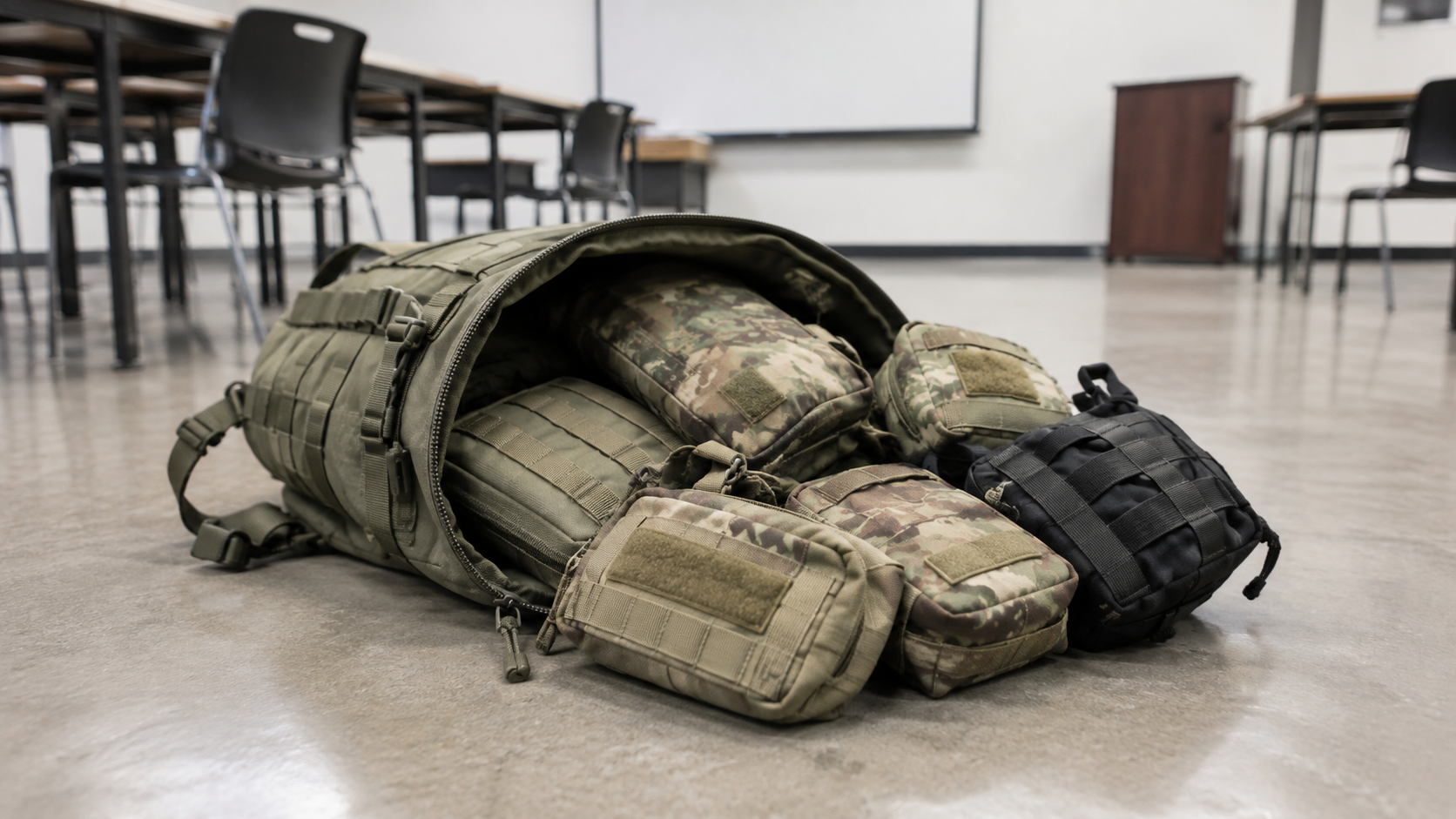
How should the resource be distributed?
One of the basic TCCC principles regarding the use of medical equipment is very simple: when providing care, the equipment from the casualty’s own IFAK should be used first.
Joint Trauma System training modules emphasize this separately for both Combat Lifesavers and medical personnel. The CLS bag is used when the resources of the individual first aid kit are no longer sufficient or when equipment not contained in the IFAK is required. And this principle significantly changes the entire approach to planning.
If a group consists of five people and each of them has a complete IFAK, we do not need to put another five complete sets into the group bag “in case all five become severely wounded at the same time.” Part of the medical resource has already been distributed among the personnel.
Therefore, the group bag should solve different problems:
- provide a reserve when one IFAK is insufficient for a single injury;
- allow several injuries or several casualties to be managed simultaneously;
- add equipment that does not make sense to duplicate in every individual first aid kit;
- compensate for mission-specific risks;
- give the group enough resources until the casualty is handed over to the next level of care.
That is why a group bag is not a “large IFAK.” It is a reserve and an expansion of capability.
Who actually needs a group medical bag?
A group medical bag is primarily needed by small units or teams that may operate for some time without the direct presence of a medic but have a trained service member capable of providing care beyond the use of their own IFAK.
The most typical example is a group that includes a Combat Lifesaver (CLS). In this case, individual first aid kits remain the primary source of equipment for treating a specific casualty, while the group bag creates an additional reserve and makes it possible to manage several injuries, several casualties, or use equipment that would be impractical to duplicate in every IFAK.
At the same time, the mere presence of a group bag does not mean that it should be identical for every unit. Its contents depend on the level of training of the people who will use it. Within the TCCC system, All Service Members (ASM), Combat Lifesaver (CLS), Combat Medic/Corpsman (CMC), and Combat Paramedic/Provider (CPP) are distinguished, and each of these levels has a different scope of permitted interventions.
Therefore, there is little sense in issuing a group in which everyone has only basic TCCC training a bag packed like a medic aid bag. Likewise, a group with a CLS may find that a pack of spare tourniquets and gauze alone is not enough. And if a medic works continuously with the group, some of the functions of a separate group bag may already be covered by the medic’s aid bag.
In other words, the need for a group medical bag is determined not by the size of the group itself, but by the gap between what individual IFAKs can provide and the level of care the group may need before the casualty is handed over to a medic or to the next stage of evacuation.
If the group includes only personnel with basic training
In such a group, there is little sense in creating a “small medic bag” with IV/IO equipment, medications, advanced airway equipment, and other items that no one knows how to use or is authorized to use.
Shared equipment in this case may be primarily reserve and logistical:
- additional hemorrhage-control supplies;
- hypothermia prevention equipment;
- additional dressings;
- immobilization equipment;
- litters or other casualty-movement equipment;
- additional casualty cards;
- gloves, tape, markers, and other consumables.
If the group includes a Combat Lifesaver
This is where the classic concept of a CLS bag becomes relevant.
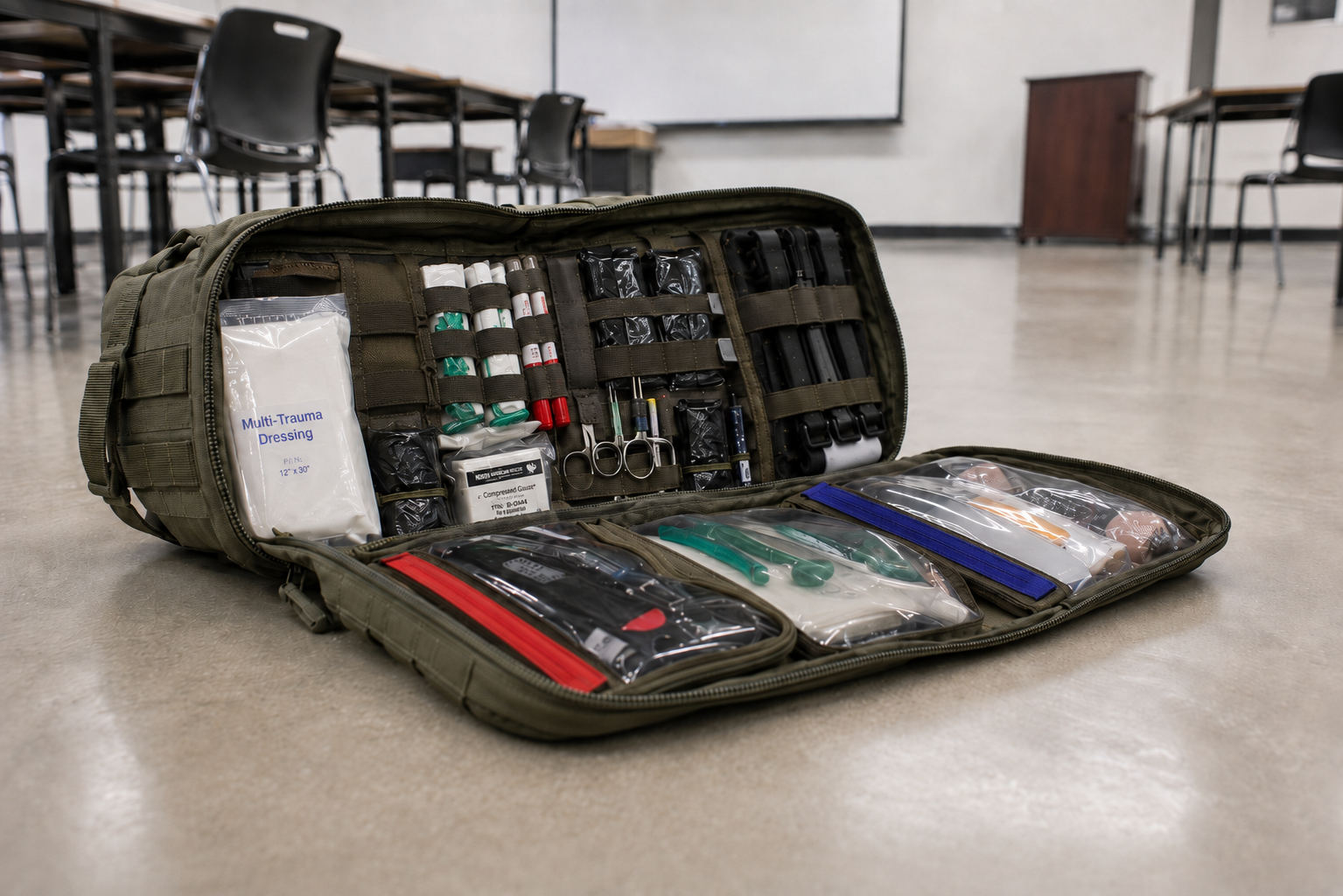
JTS describes the CLS bag (3, 4) as equipment intended for non-medical personnel with training beyond the basic level. Part of its contents duplicates the IFAK — tourniquets, dressings, chest seals, and so on — precisely because a single casualty may have multiple injuries and require more material than is available in their own first aid kit.
At the same time, the CLS bag usually adds items that are impractical to issue to everyone because they take up a lot of space: active or passive hypothermia prevention equipment, additional wound-care materials, splints, cravats, and other equipment. JTS explicitly notes that the contents of CLS bags may vary depending on the specific unit and service.
For small groups that may operate for some time without the direct presence of a medic, it is reasonable to have at least one service member with advanced tactical medicine training and access to group medical equipment. The specific number of such trained personnel and the amount of equipment should be determined by the mission, group size, expected injury pattern, availability of a medic, and anticipated time to evacuation.
For a small autonomous group, this means something simple: if a medic is not physically present with the group but there is a trained CLS, a separate group medical resource makes sense.
If a medic works continuously with the group
The structure changes here as well. A medic’s aid bag already contains a larger amount of TCCC equipment for managing multiple casualties and equipment for a broader scope of care. JTS gives examples such as vascular-access equipment, blood or other resuscitation products, medications, and more complex equipment appropriate to the competencies of medical personnel.
In such a group, there is not necessarily a need to create another huge CLS bag in parallel. Instead, part of the reserve can be distributed through cross-loading — spread among other members of the group. JTS also explicitly mentions this approach as a way to avoid turning the medical backpack into an excessively heavy load.
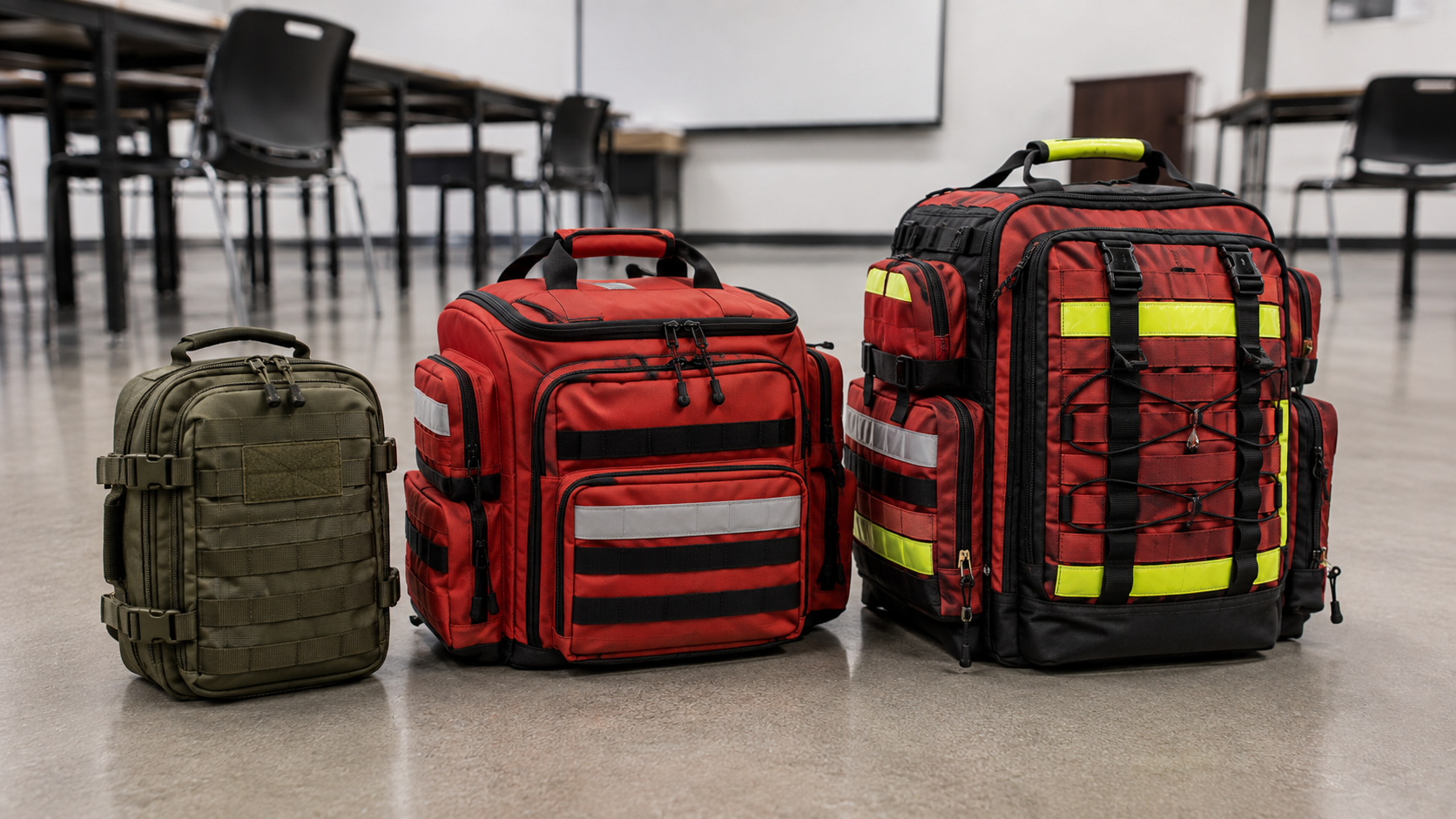
Therefore, a group medical bag should be viewed not as a standard kit for a certain number of people, but as an additional medical resource for a specific group. Its contents should correspond to who will use it, what injuries are expected, and how long the group must be capable of supporting a casualty independently.
Who should be responsible for the bag?
Because the bag is a shared group resource, a specific person should be responsible for its completeness and readiness. Otherwise, responsibility is easily blurred: someone used supplies, someone failed to report it, and the shortage is discovered only before the next mission. It is therefore reasonable to designate a primary responsible person in advance who will monitor the condition of the bag, replenish used equipment, and ensure that its contents match the specific mission.
If the group has one trained CLS, it is logical for that person to be the primary user and to monitor the completeness of the bag. If there are several CLS personnel, the bag should still have a designated owner for the specific mission.
The responsible person’s job is not simply to carry the backpack. They should also know:
- where each module is located;
- what has been used;
- what needs to be replaced;
- which materials have expiration dates;
- whether packaging remains sealed;
- whether mechanical devices are functional;
- whether the contents of the bag match the current mission.
JTS recommends checking JFAK, CLS bags, and medical bags before, during, and after training and combat missions, promptly replacing used or damaged supplies.
At the same time, the system should not be built so that only the responsible person knows where everything is. The organization of the bag should be understandable to everyone who may potentially use it. At least several members of the group should be able to locate the main modules and critical equipment without being told where to look.
Because a perfectly organized medical backpack that only its owner understands stops being an effective system the moment that owner becomes the casualty.
Equipment should match the competencies of the person using it
The division into IFAK, CLS bag, and medic aid bag is convenient for training and equipment organization, but in practice their contents partially overlap. Tourniquets, hemostatic gauze, chest seals, dressings, hypothermia prevention equipment, and documentation may be present in several types of kits at the same time. The difference lies not so much in the item itself as in its quantity, the nature of the mission, the number of potential casualties, access to the next level of medical care, intended purpose, and the interventions the person using the bag is capable of performing.
JTS explicitly states that kit contents partially overlap but should correspond to the individual user’s skill level. At the same time, there is no single universal list for CLS personnel or medics — equipment is adapted according to the type of service, unit SOP, and planning for the specific mission.
Therefore, medical capability is not located inside the backpack — it exists in the combination of the person, their skills, and the equipment available to them.
Putting an IV catheter, TXA, or an advanced airway kit into a backpack is easy. But the mere presence of equipment does not create competence. On the contrary, JTS specifically emphasizes that personnel should not carry equipment they do not know how to use or do not plan to use.
The May 1, 2026 TCCC Guidelines also repeatedly link more advanced interventions to training, experience, authorization, and medical direction. For example, transfusion of unscreened fresh whole blood should be performed by trained personnel under appropriate medical direction.
This is fundamentally important when packing the bag.
Do not create a capability on paper that the group does not actually possess.
How many casualties are we planning to treat?
JTS directly addresses the problem of medical equipment weight: excess load affects the combat load, so unnecessary weight should be minimized without sacrificing required capability. Historical data, the nature of the threat, evacuation capabilities, and the expected injury profile should all be used in planning.
For a group of 4–5 people, there is little sense in calculating the group bag as though every member will become severely wounded at the same time. That approach will very quickly lead to excessive equipment weight without a proportional increase in real medical capability. JTS separately emphasizes that medical equipment should be planned with consideration of combat load, the nature of the threat, the expected injury profile, and evacuation capabilities.
Therefore, for a small group in which everyone already has their own IFAK, it is more reasonable to calculate not a full additional kit for every person, but the additional resource above the individual first aid kits. Its amount should correspond to how many casualties the group realistically needs to be capable of supporting simultaneously until handover to a medic or evacuation.
Baseline scenario
 Organization is sometimes more important than one more tourniquet
Even correctly selected equipment can lose a significant portion of its value if the bag is poorly organized. Supplies needed during the early stages of care should be accessible without unnecessary searching, while equipment used together should be grouped into separate modules. This approach also aligns with JTS practical recommendations: priority equipment should be placed closer to quick access, and related items should be stored together.
For a group bag, a simple MARCH-based structure works well:
M — Massive hemorrhage
A — Airway
R — Respiration
C — Circulation
H — Hypothermia and head injury
PAWS, documentation, and evacuation equipment can be separated into their own modules.
The labeling should also be understandable not only to the owner of the bag. Any trained member of the group should be able to open it and, without ten minutes of archaeology, find an additional tourniquet, hemostatic dressing, or hypothermia-prevention equipment.
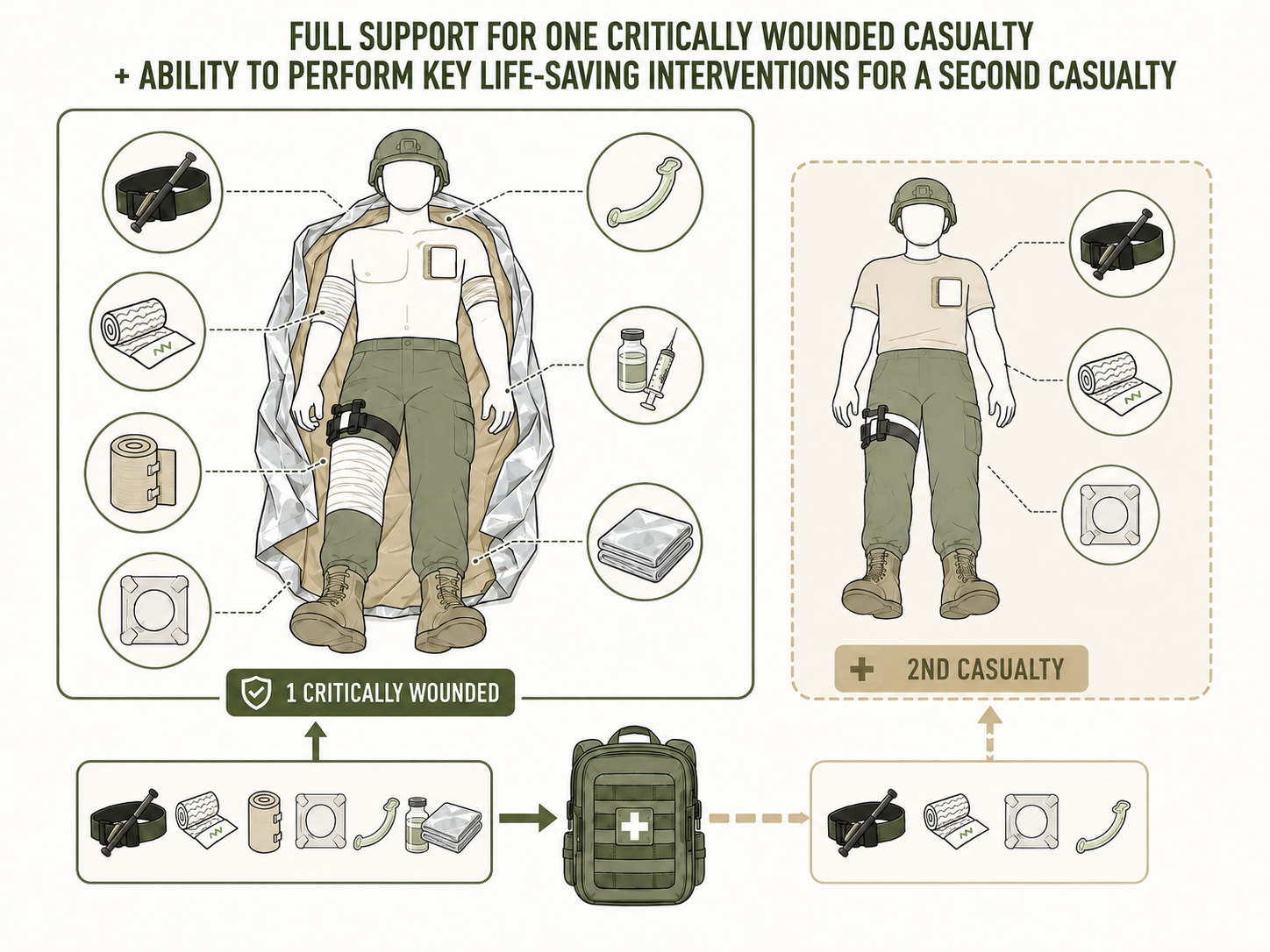
Full support for one severely wounded casualty + the ability to perform key lifesaving interventions for a second casualty.
This is not an official CoTCCC standard, but a practical planning model. It is based on the assumption that every casualty already has their own IFAK, while the group bag should provide additional resources beyond it — primarily for a more complex injury, a second casualty, or delayed evacuation.
If the nature of the mission involves a higher probability of simultaneous multiple casualties, this does not necessarily mean that the entire required reserve must be carried directly in the group bag. In that situation, the resupply plan becomes more important: where the additional medical stock is located, who is responsible for delivering it, and how quickly it can reach the group. Unit vehicles, unmanned ground or aerial platforms, and other available delivery methods may be used for this purpose.
The goal of medical logistics is not to carry the entire medical stock on your back at all times, but to ensure access to it when it is actually needed.
Possible example of a loadout for a group of 4–5 people
The following is not a “standard CoTCCC bag,” but an example of how a minimum group reserve can be built for 4–5 people if each already has an IFAK and the group has trained CLS-level users.
Massive hemorrhage
Approximately:
- 2–4 additional tourniquets;
- 4 hemostatic gauze dressings;
- 4–6 packs of compressed or plain gauze for wound packing and dressing;
- 3–4 bandages of different sizes;
- 1 large abdominal dressing.
This does not mean that each of the five people receives another complete set. Your task is to have enough resources for a situation in which one IFAK has already been used, but the hemorrhage requires a second tourniquet, repeat wound packing, or simultaneous control of several wounds.
The May 1, 2026 TCCC Guidelines recommend the use of CoTCCC-recommended tourniquets for life-threatening extremity hemorrhage and hemostatic dressings with direct pressure for compressible hemorrhage where a tourniquet cannot be applied.
Airway and respiration
This is where equipment appears that makes little sense to duplicate five times:
- additional NPAs with lubricant;
- one compact bag-valve-mask (BVM), if personnel are trained to use it;
- 2–3 additional chest seals;
- additional decompression needles (preferably the type the group is trained to use) — only in accordance with training, current protocols, and the authorizations of the specific unit;
- where justified — a compact pulse oximeter.
The May 1, 2026 TCCC Guidelines provide for the use of a BVM when ventilation is inadequate and recommend pulse oximetry in appropriate casualties, including when significant TBI is suspected.
Hypothermia
This is precisely where the group bag can add what is often physically impossible to fit properly into an IFAK.
For a small group, I would consider:
- 1–2 complete hypothermia prevention systems, both passive and active;
- additional insulation material depending on the season and evacuation plan.
TCCC recommends early and aggressive prevention of heat loss in trauma casualties, including insulation from the ground, protection from wind and precipitation, and, when possible, active warming. JTS separately lists active and passive hypothermia prevention equipment among the typical additional contents of a CLS bag. And this is a good example of why a shared kit exists at all: it is far more logical to carry one or two effective warming systems per group than to try to stuff one into every IFAK.
PAWS: wounds and splints
It is logical to add the following to the group kit:
- one universal moldable splint;
- several cloth cravats for additional stabilization;
- additional gauze;
- elastic bandages;
- several rigid protective eye shields;
- materials for covering larger superficial injuries or burns.
Splints, cravats, additional wound-care supplies, and eye shields are included among the equipment CLS personnel work with in the JTS training system.
Small items that always seem to run short
A separate small module is worth dedicating to:
- nitrile gloves;
- trauma shears;
- medical tape;
- permanent marker;
- additional casualty cards required by the unit; in TCCC, DD Form 1380 (TCCC Casualty Card);
- means of securing the card to the casualty;
- other inexpensive consumables.
Documentation should be as accessible a part of the equipment as the other items needed during care. TCCC provides for documenting the casualty’s condition, interventions performed, and changes over time, followed by transfer of this information together with the casualty to the next stage of care. Therefore, having a single card that suddenly gets wet, is lost, or has already been used is a fairly weak logistics plan.
Medications, TXA, IV/IO, and blood
Medications and equipment for advanced interventions should be included in the group bag only when their use is provided for by the unit’s current protocol and the group includes a person who is trained and authorized to use them. Storage conditions, expiration dates, and the ability to monitor their condition during the mission must also be considered separately.
The same applies to:
- IV/IO access;
- TXA;
- blood products;
- calcium;
- advanced airway equipment;
- junctional devices;
- other medic-level interventions.
In TCCC, IV/IO, TXA, hemostatic resuscitation, and other advanced interventions have specific indications, while a number of procedures additionally depend on training, experience, authorization, and medical direction. If the group does not include a person who can correctly use a particular piece of equipment, simply having that equipment does not create additional capability.
It creates weight, confusion, and a false sense of readiness.
A different situation arises when a medic joins the group. In that case, the structure of the group equipment may change literally before a specific mission: part of the medic’s medical stock can be distributed among group members, while the shared kit can be supplemented with specific equipment according to the expected evacuation time and threat profile.
The bag should change with the mission
The same group may need different equipment on different days. JTS recommends using threat-based planning: taking into account available medical resources, local capabilities, potential casualties, and changes in the injury pattern. Movement methods and evacuation capabilities are also important.
In practical terms, before stepping off it is worth asking several questions:
How long will we realistically remain with the casualty?
Where is the nearest medic or next-level care facility?
What is the actual route for handing the casualty over?
Are we moving on foot or by vehicle?
Which injuries are most likely on this specific mission?
What number of simultaneous casualties do we consider a realistic scenario?
Are there specific seasonal risks?
Can we distribute part of the reserve among group members?
For a group operating only a few minutes away from a medic and a group that may potentially remain autonomous for several hours, the same packing list simply makes no sense.
So what should be in a group medical bag?
The contents of a group medical bag should be determined not by a universal list, but by the real operating conditions of the specific group. The starting point is that every member already has their own IFAK, while shared equipment should supplement that resource — providing reserves for more complex injuries, multiple casualties, longer evacuation delays, and interventions that cannot or should not be supported through individual first aid kits.
Further contents depend on the training level of the people who will use the bag. A CLS, medic, or other trained specialist may have a different scope of permitted interventions, so medications, IV/IO access, TXA, blood, advanced airway equipment, and other specialized equipment should appear in the bag only when trained and authorized personnel are available to use them.
It is equally important to consider the nature of the mission, expected time to evacuation, method of movement, ability to resupply quickly, and risk of simultaneous casualties. If a mission creates a higher demand for medical resources, that does not mean that the entire reserve must be carried on the group’s backs. Part of the reserve may be better kept at the next logistical level, with a method for rapidly delivering it to the group planned in advance.
Ultimately, a well-packed group bag is not the maximum amount of medical equipment that can be fitted into a backpack. It is a balanced kit that matches the capabilities of the personnel, the mission profile, and the real duration of autonomous casualty care. That is why it should be viewed as part of the group’s medical system, not as just another, larger individual first aid kit.
Sources
Current Tactical Combat Casualty Care Guidelines — Joint Trauma System / Committee on Tactical Combat Casualty Care, edition used: May 1, 2026, verified against the original PDF title page. Tactical Field Care sections: Massive Hemorrhage, Airway Management, Circulation, Prevention of Hypothermia, and Documentation of Care.
TCCC Combat Lifesaver Course Plan — Joint Trauma System, TCCC-CLS-09-01, April 1, 2026 edition, verified against the original PDF title page. Used for the training framework and competencies; clinical recommendations are cited from the May 1, 2026 TCCC Guidelines.
TCCC CLS Module 02: Medical Equipment — Joint Trauma System / Deployed Medicine. TCCC-CLS-PPT-02_30 MAY 26, May 30, 2026 edition; date verified against the PDF change log and footers.
TCCC Combat Medic/Corpsman Module 2: Medical Equipment — Joint Trauma System / Deployed Medicine. Electronic package: Deployed Medicine, version 5; no calendar revision date is stated in its text. Used for equipment organization, distribution, inspection, and resupply; clinical recommendations were checked against the May 1, 2026 TCCC Guidelines.
Revision date: